Nederlands
Het kan meerdere oorzaken hebben waarom een verbrandingsmotortje onregelmatig loopt en/of plotseling stil valt, al dan niet mede daardoor. Eén ervan is het onregelmatig wegvallen van de vonk op de bougie. Het is erg handig om eerst vast te stellen of dit al dan niet het geval is voordat men zich in allelei ander onderzoek stort.
Nu is het wel eenvoudig om te kontroleren of er uberhaupt een vonk komt door de schakelaar voor de primaire bobinestroom in te drukken en daarbij de bougiekabel dicht bij de massa van de motor te houden. Dat wil echter nog niet altijd zeggen dat er niets aan de hand is met het ontstekings mechanisme. Het kan namelijk voorkomen dat de vonken toch niet bij iedere cyclus over de bougiepunten overslaan als de motor loopt en dat is minder eenvoudig om vast te stellen. De motor loopt dan onregelmatig en kan daardoor tenslotte stil vallen. Er zijn diverse oorzaken mogelijk voor dit verschijnsel zoals:
- Te grote overgangsweerstanden van ingebrande of vervuilde kontaktpunten waardoor er onvoldoende stroom loopt door de primaire wikkeling van de bobine. Bedenk dat de ohmse weerstand van de primaire bobine wikkeling ook slechts enkele ohms bedraagt en dat de primaire stroom van 3 tot 5 ampere fors is.
-Het zweven van de schakelaar bij bepaalde toerentallen. Originele "puntjes" zoals die bij industriele motoren gebruikt worden (werden) zullen daar in het algemeen weinig last van hebben, maar willekeurig andere elektrische schakelaars vaak wel. Die zijn doorgaans niet gemaakt voor hoge schakel frekwenties.
- Een beroete of natte bougie. Dit verschijnsel treedt nog al eens op bij gebruik van een niet goed afgestelde klassieke carburateur (bij gebruik van de "Benzinedamp Carburateur" treden deze verschijnselen niet op).
- Vonkoverslag van de hoogspanning op andere plaatsen in het electrische circuit dan op de bougie door onvoldoende isolatie van hoogspanning voerende delen.
Het meten van de primaire stroom door de primaire wikkeling kan in de eerste twee gevallen misschien wel enig uitsluitsel geven maar niet in de laatste twee gevallen omdat die dan toch normaal zal zijn.
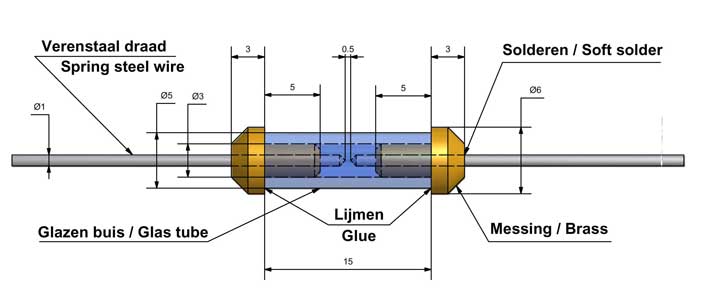
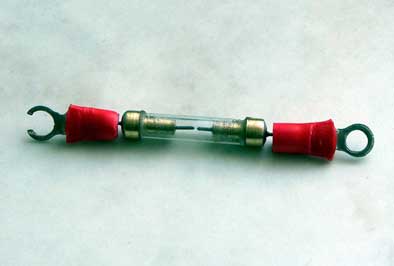
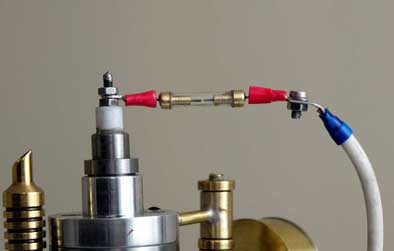
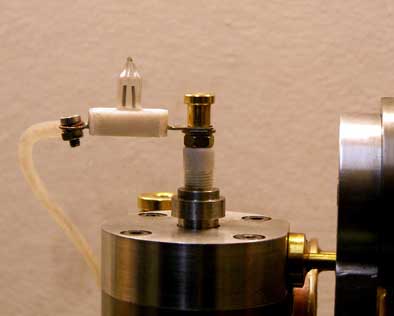
Voor het het kontroleren of de vonken ook konstant en regelmatig op de bougie overspringen als de motor loopt heb ik een kinderlijk eenvoudig testertje gemaakt; zie onderstaande tekening en foto's. In een glazen buisje zijn met de bekende acrylaat seconde lijm twee messing propjes bevestigd waarin stukjes verenstaaldraad zijn gesoldeerd. De wat aangepunte uiteinden van deze draden staan op ca 0,5mm van elkaar in het buisje. Als dit testertje aangeloten wordt tussen de bougie en de hoogspanningskabel zal er een minuscuul doch goed zichtbaar vonkje overslaan tussen deze puntjes tegelijk met de onzichtbare vonk op de bougie in de cilinder. Als er geen of onregelmatige vonkjes zichtbaar zijn in het buisje kan men er zeker van zijn dat dit ook het geval is op de bougie in de cilinder omdat beide vonken in serie staan. Het vonkje oefent blijkbaar geen nadelige invloed uit op de energie van de vonk op de bougie; al mijn motortjes lopen net zo goed met als zonder deze tester. Het is natuurlijk niet de bedoeling om de tester aangesloten te laten als alles in orde is.
De kleine hoeveelheid zuurstof in het gasdichte buisje zal na enkele vonken snel verdwenen zijn zodat de draadpuntjes niet verder zullen oxideren.
Alleen de afstand van 0,5mm tussen de aangepunte draadeinden is van enig belang, enerzijds omdat er dan gemakkelijk vonkoverslag zal plaatsvinden (we willen immers niet de tester testen) en anderzijds om het vonkje zo klein mogelijk te houden omdat ik denkt dat dit de invloed op de bougievonk minimaal maakt. Van alle andere maten kan m.i. desgewenst afgeweken worden.
Deze tester is dus vooral handig als als er sprake is van onregelmatig vonken omdat zoiets anders moeilijk te konstateren is. Er bestaat wellicht iets soortgelijks zoals ik nu gemaakt heb, maar dat is mij toch niet bekend. Het is natuurlijk ook mogelijk om metingen verrichten met een electronen oscilloscoop, maar die is vaak niet beschikbaar en vereist bepaalde kennis om daar goed mee om te gaan. Voorts is het ook wel een beetje link voor een scoop om er metingen mee uit te voeren aan de hoogspanningskant van de bobine.
English
There are several possible causes why an IC engine runs irregular and/or stops suddenly. One of the causes is irregular dropout of the spark on the spark plug. It is very skilful first to determine if this is the case before exhausting themselves to other and, may be, needless investigations.
Of course it is easy to find out if there is a spark anyway by pressing the points (electrical switch) for the primary current of the high tension coil and check for a spark when holding the high tension cable near the mass of the engine. But that doesn't mean always that nothing is wrong with the ignition system. It can happen that the sparks not always occur at every engine cycle when the engine is running and that is less easy to find out.
In that case the engine will run irregular and will finally stops most of the time. There are several possible causes for this phenomenon:
- Too high contact resistance of burned-in or contaminated points causing an insufficient primary current through the high tension coil. Mind that the electrical resistance of the primary coil is also only some few ohm's while the 3 to 5 amps current is rather high.
- Floating points of the switch at certain speeds. In general points that original are made for industrial engines will not suffer from this, but any other arbitrary electrical switch can. Most of the time they are not made for high mechanical switch frequencies.
- Rooted or wet spark plug. This is a well known phenomenon with miss-adjusted classic carburetors. When using the "Petrol Vapour Carburetor" these phenomenon's don't occur by the way.
- Spark flash-over at other places in the electrical circuit than on the spark plug due to insufficient isolation of parts with high electrical tension.
May be measuring the current through the primary coil can give any exclusion in the first two cases, but for sure not in the last two cases because this current will be normal then.
To check for a regular spark when the engine is running I made a childish simple little tester; see above drawing and pictures. Two brass props with spring steel wires soldered in it are glued in a small glass tube with the well known acryl ate instant glue. The distance between the somewhat pointed ends of the wires is about 0,5mm. When this tester is connected to the spark plug and the high tension cable (see picture) there will be a tiny but well visible spark between the wire ends simultaneously with the invisible spark on the spark plug in the cylinder. If you see no or an irregular spark in the glass tube you can be sure that this is also the case for the spark on the spark plug because the two sparks are serial connected.
Apparently the little spark in the glass tube has no or neglect able influence on the spark on the spark plug; all my engines run even with or without this tester. Of course it is not the intention to keep this tester connected when everything is found to be OK.
Only the 0.5mm dimension between the pointed wire ends is of any importance, on the one hand to make the spark flash-over easy to occur (we don't want to test the tester) and on the other hand because to keep the spark as small as possible to avoid any significant energy loss. All other dimensions are not critical at all so you can deviate from them if you like.
Because the tester is air tight the small amount of oxigen in it will disappear fast after some sparks so the wire points will not oxidize any further.
So this tester is especially skilful in case of suspecting irregular sparks because that is rather difficult to discover with a running engine. I really think there must be something like this existing already, but I never saw it till now. Of course it is possible to use a electronic oscilloscope but that is not available most of the time and you need some special knowledge to work with it well. Besides it is a little bit risky to connect such a scope to the high tension part of this ignition circuit.
Een aardig alternatief
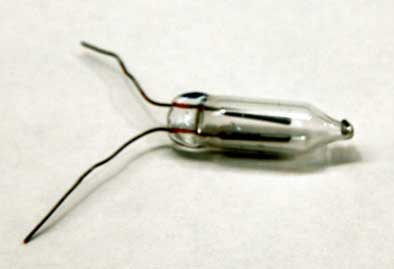
Kort na het maken van de tester zoals hierboven beschreven vond ik in een van mijn rommeldozen een neon signaal lampje zoals dat o.a. gebruikt wordt (of werd) in sterkstroom apparaten zonder electronica zoals bijvoorbeeld strijkijzers; zie linker foto. Het is een gasontladingslampje dat ontsteekt bij iedere spanning boven 220 volt waarbij de stroom erdoor normaliter begrensd wordt tot ca 0,5 mAmet een ingebouwd weerstandje van 50 KOhm. De hoogspanning van de boubine is natuurlijk meer dan hoog genoeg om het lampje te laten ontsteken. Omdat de stroom die de bobine levert aan de hoogspanning in de orde van 0,5 tot 1 mA ligt kan de begrenzingsweerstand van 50 Kohm worden weggelaten. Aangesloten tussen de bougiekabel en de bougie (zie foto midden) ontstaat er een zeer duidelijk zichtbare rode ontlading elke keer als er stroom door de bougie loopt. Omdat de gasontlading in het lampje zeer snel reageert is zo iedere vonk over de bougiekontakten duidelijk te volgen; zie de video. De wat onregelmatige glimontladingen daarop zijn in dit geval niet het gevolg van onregelmatig vonken maar van stroboscopische effecten van de video opname. De motor loopt net zo goed met als zonder deze vonkentester zodat ik mag konkluderen dat geen of een verwaarloosbare invloed is van het glimlichtje op de energie van de bougievonk.
Het probleem kan zijn dat deze glimlampjes niet gemakkelijk meer verkrijgbaar zijn omdat voor de huidige apparaten met electronica meestal LED lampjes gebruikt worden voor signaleringen. LED lampjes blijken niet te onsteken als ze op deze manier worden aangesloten op de bougie. Er moeten echter nog vele van dergelijke glimlampjes in deze wereld aanwezig zijn maar wellicht is het dan nodig om die uit een oud apparaat te slopen.
A nice alternative
Discussions on Internet Forums about my spark tester as on top of this page triggered me to pick up a small discharge lamp that is (was) used for signal functions in non electronic devices like flat-irons. I worked for 40 years at Philips Lighting and this kind of lamps were made there; see picture on the left. It are discharge lamps with two cylindrical electrodes with some emitter on it and the lamp is filled with low pressure neon. The lamp ignites at every voltage higher than 220 volt and the current through it is normally limited to about 0.5 milli amps with a 50 KOhm resistor. Connected between the HT cable and the spark plug (see picture in the middle) this lamp will ignited at the high tension pulses of the coil and the current through it will be normal for this lamp since the high tension current of the coil is also anywhere between 0.5 and 1 milli amps; so the 50 KOhm resistor can be omitted here. The reddish discharge reacts very fast so you can follow every spark on the spark plug at least with engine speeds up to about 1000 RPM. You can see that on the video where this lamp is connected to the spark plug of my "Disk Valve 4-stroke Engine" running at about 800 RPM. The somewhat irregular discharges on that video are a result of stroboscopic video effects; in reality the discharges were very regular in this case of the nice running engine. The engine runs as well with or without this spark tester so I may conclude that it has no or neglect able influence on the energy of the spark on the spark plug.
May be the obtain ability of this kind of signal lamps is a problem nowadays be there must be still a lot of them in this world, although it is possible that you have to dismantle an old device for it.